
Between 2020 and 2025, the 14-county Charlotte region added more than 289,000 residents and crossed three million people. Over that same stretch, the average U.S. metro growth rate fell from 1.1% to 0.6%. Charlotte was one of the few exceptions, joining Houston, Dallas–Fort Worth, Atlanta, and Phoenix among the national leaders in adding residents.
Supply chains follow demand. And demand keeps moving south.
For a growing number of manufacturers, retailers, importers, and consumer brands, the largest available margin is no longer inside the four walls of the warehouse. It is in where that warehouse sits. Networks built around a customer base from ten years ago are quietly expensive to run — more transit miles, more transfers, more expedites, more missed delivery windows.
The question is no longer whether the Southeast belongs in a modern distribution strategy. It is how to use the region well.
The Southeast Is Reshaping Distribution Networks
Companies are repositioning inventory closer to expanding markets while improving access to interstate corridors, manufacturing centers, and East Coast ports. Done correctly, that repositioning delivers on several fronts at once:
- Lower transportation spend per unit shipped
- Faster, more consistent delivery performance
- More customers reachable in one to two days
- Better inventory positioning across the network
- More flexibility when demand shifts
Distribution strategy has become less about where products are stored and more about how quickly and predictably, they reach the customer.
Why Charlotte Has Become One of the Nation’s Premier Logistics Hubs
Among Southeast markets, Charlotte stands out — and the case is quantitative, not just geographic.
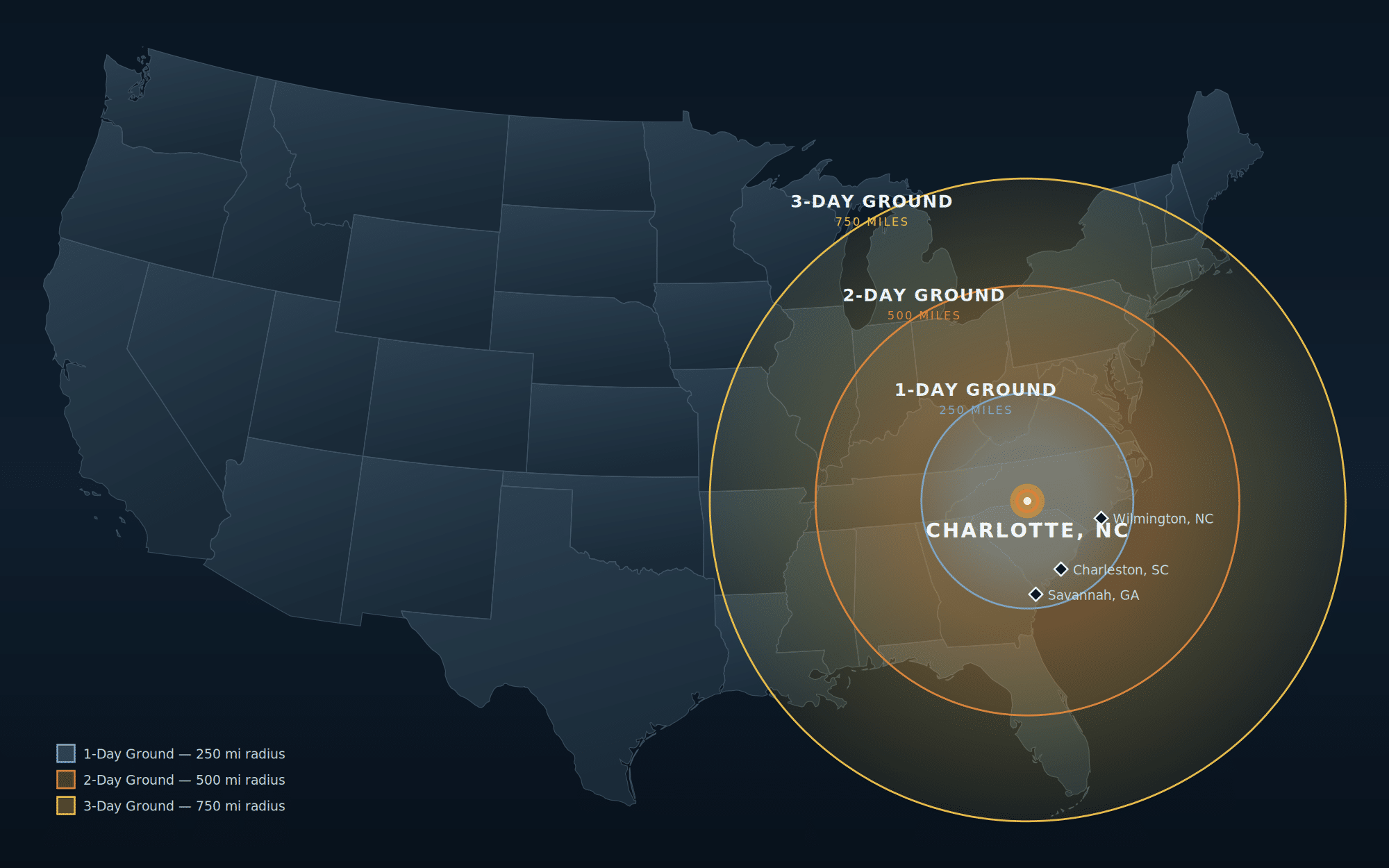
Highway access. Four major interstates — I-77, I-85, I-40, and the I-485 loop — put Charlotte within a day’s drive of roughly half the U.S. population. Positioned near the midpoint between New York and Miami, the region can reach approximately 100 million people within a one-day truck route.
Rail. The region is served by two Class I railroads, Norfolk Southern and CSX, along with regional lines. Many surrounding counties have dual rail service.
Ports. Charlotte sits within roughly 250 miles of three deepwater ports — Wilmington, Charleston, and Savannah — which shortens drayage cycles and reduces the inland transit penalty importers absorb at other inland points.
Air. Charlotte Douglas International Airport supports both domestic and international freight connectivity, with 180-plus direct destinations.
Sustained demand growth. The Charlotte Regional Business Alliance projects the region will grow to roughly 4.6 million people by 2050 — an increase of more than 50%. A distribution point placed here does not just serve today’s demand curve; it stays relevant against the next two decades of it.
For a growing number of companies, Charlotte has evolved from a warehouse location into a control point in the network.
Transportation Cost Is Usually the Deciding Factor
Warehouse rates get the attention in an RFP. Transportation is where the money actually is.
Over a multi-year contract, linehaul, drayage, and accessorial charges typically dwarf the storage line item. Cutting transit miles, consolidating freight more effectively, and moving inventory closer to the customer produce savings that compound every month— and they usually improve service at the same time, which is rare in logistics.
For importers, efficient drayage from Southeast ports shortens inland transit and eliminates unnecessary handling. For retailers and manufacturers, well-placed full truckload (FTL), less-than-truckload (LTL), and cross-dock operations move product through the network with fewer touches and fewer surprises.
The result is a distribution network that is both more efficient and more resilient.
Modern Distribution Requires More Than Warehouse Space
As supply chains grow more complex, shippers increasingly look for a partner that can handle multiple functions under one operational umbrella rather than stitching together four vendors and hoping they talk to each other.
Warehousing remains the foundation, but most operations also depend on:
- Transportation management
- Cross-docking
- Rail-served warehousing
- Food-grade, temperature-controlled, and chemical-segmented storage
- Drayage and freight brokerage
- Inventory visibility and reporting
- Retail distribution and compliance
- B2B and B2C fulfillment
Consolidating these functions shortens the communication chain, removes finger pointing between vendors, and gives shippers a single view of what is actually happening to their freight.
Scaling Without Rebuilding Your Network
Very few businesses will operate five years from now the way they operate today. Store counts change, SKU counts expand, customer requirements tighten, and seasonal peaks get sharper.
The right logistics partner absorbs those changes without forcing a redesign of the entire distribution strategy. Whether you are entering new markets, adding inventory depth, or supporting higher shipment volumes, flexibility has become one of the most valuable things a 3PL can offer — and one of the hardest to evaluate on paper.
A practical test during selection: ask a prospective provider how they handled a customer’s unplanned 30% volume increase last year. The specifics of that answer will tell you more than any capabilities deck.
Why Companies Choose Distribution Technology
Companies do not partner with Distribution Technology because of square footage alone. They partner with us because location, capability, and operational discipline arrive together.
From our Charlotte operations, we provide:
- More than 1.2 million square feet of warehouse capacity
- Comprehensive transportation services, including drayage, FTL, and LTL brokerage
- Cross-docking and retail distribution
- Food-grade, temperature-controlled, and chemical-segmented warehousing
- Rail-served facilities
- Inventory management and fulfillment services
- Logistics programs built around each customer’s actual operation, not a standard template
We have been doing this in Charlotte since 1971 — 55 years of operating through freight recessions, capacity crunches, port congestion, and demand swings that looked nothing like the forecast. Our food-grade operations are audited annually and have consistently earned a superior rating. Our warehouse consolidation work has been recognized with an award from one of the nation’s largest retailers.
Ultimately, the partnerships that last are built on communication, operational discipline, and consistent execution. Those are not differentiators you can claim in a proposal. They show up in the weekly numbers.
The Future of Distribution Continues to Move South
Companies that position inventory closer to their customers — and closer to efficient transportation — will compete better on both cost and service.
The Southeast offers a combination of market access, infrastructure, port connectivity, and long-term growth that few regions can match, and Charlotte has become one of the region’s defining logistics hubs. For organizations evaluating the next phase of their distribution strategy, the question is no longer simply where to put a warehouse. It is how to build a supply chain that is faster, more resilient, and ready for demand that has not arrived yet.
Ready to Look at Your Network?
If you are evaluating a Southeast distribution point — or questioning whether your current network still matches the customers you serve — we will work through it with you.
Send us your current shipping profile: origin points, destination mix, monthly volume, and storage requirements. Our team will outline what a Charlotte-based operation would look like, including space, transportation options, and where the cost actually moves.
No lengthy RFP required. Just a direct assessment from a team that has been running distribution out of Charlotte since 1971.
Connect with Distribution Technology – or call 704-567-5587 to speak with our team directly.