
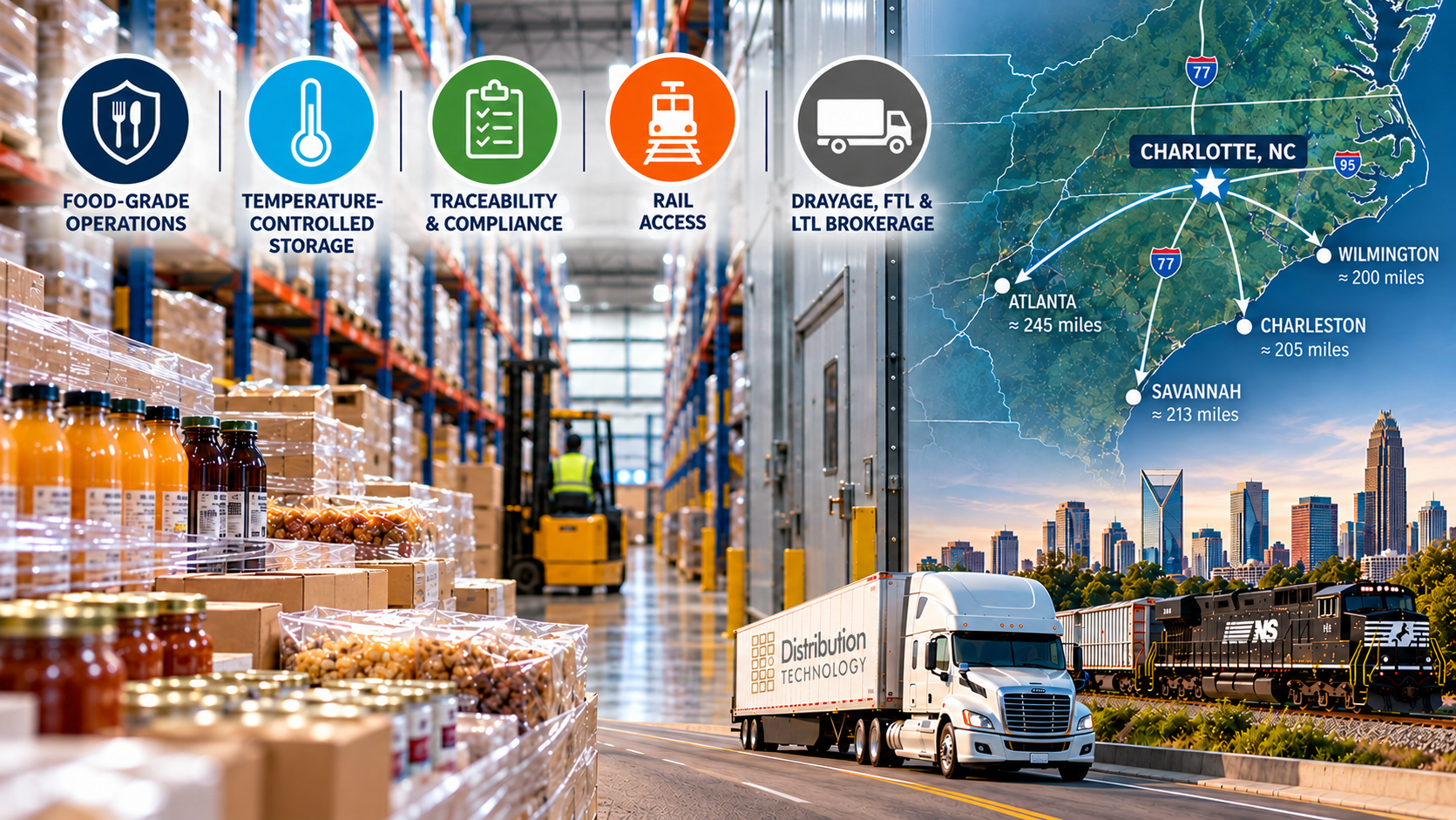
For food and beverage companies, a warehouse problem rarely stays in the warehouse. A temperature excursion, an untraceable lot or a failed audit can lead to product losses, retailer chargebacks and difficult conversations with customers. Choosing a food-grade warehouse in Charlotte, NC deserves more scrutiny than comparing rates per pallet.
With more than 50 years of experience serving the Charlotte market, Distribution Technology understands the questions food and beverage shippers should ask before selecting a storage partner.
What Makes a Warehouse Food-Grade?
Food-grade warehousing is defined as much by day-to-day operating practices as by the building itself. Applicable FDA requirements depend on the products and activities involved, so ask a prospective provider to demonstrate its procedures and controls.
- Documented sanitation, housekeeping and pest-control programs
- Lot and expiration-date visibility, with FIFO or FEFO rotation when required by the product
- Appropriate separation of food products from chemicals and incompatible materials
- Procedures for inspecting inbound and outbound trailers and coordinating sanitary transportation responsibilities
- Independent food-grade audits and a process for addressing findings
Ask to review the latest audit results and understand any corrective actions. An audit rating is useful, but the procedures behind it matter just as much.
How Much Temperature Control Does Your Product Need?
“Temperature-controlled” can mean different things from one facility to another. Start with your product specifications: acceptable temperature range, humidity sensitivity, monitoring requirements and tolerance for excursions. Then ask how the warehouse maintains those conditions during a Charlotte summer.
Hot, humid weather can affect chocolate, confectionery, beverages and certain ingredients. Ask whether temperatures are monitored continuously or through periodic checks, how exceptions are escalated and what records are available to customers.
Where temperature control is necessary for food safety, additional regulatory requirements may apply, depending on the facility and product. If refrigeration is required, confirm that the provider has suitable cooler capacity; temperature-controlled dry storage is not the same as refrigerated space.
What to Look for in a Charlotte Food-Grade Warehouse
Capacity That Adjusts to Demand
Seasonal inventory builds, promotions and product launches can push storage requirements well above normal levels. Ask about expansion capacity and whether additional inventory can remain on the same campus rather than being divided among multiple providers.
Access to Your Freight Network
Charlotte’s access to I-77 and I-85 makes it a practical distribution location for the Southeast and beyond. For companies moving ingredients, beverages or packaging in volume, inbound rail can also be worth evaluating. The right location and mode depend on shipment origins, destinations and freight characteristics.
Experience With Food and Beverage Requirements
Food logistics often requires lot-level reporting, expiration-date controls, retailer routing-guide compliance, appointment scheduling and disciplined receiving procedures. Ask how the provider handles these requirements and what information is available through its warehouse management system.
Transportation Coordination
A warehousing partner that also supports drayage, full truckload (FTL) and less-than-truckload (LTL) brokerage can simplify communication between receiving, storage and outbound transportation. Confirm which services are performed directly, and which are arranged through carrier partners.
Food-Grade and Temperature-Controlled Warehousing at Distribution Technology
Distribution Technology operates more than 1.2 million square feet of warehouse space across eight Charlotte buildings, including more than 500,000 square feet of food-grade storage.
- Food-grade operations audited annually by ASI, with a history of superior ratings
- More than 120,000 square feet of temperature-controlled space, including 38,400 square feet of cooler space capable of maintaining temperatures in the mid-to-upper 30s °F
- Dedicated chemical-storage facilities separate from food products
- Rail-served warehousing, including Norfolk Southern Warehouse Connect participation and 23 rail-side doors
- Transportation support through drayage and FTL/LTL brokerage
Questions to Ask Before You Choose a Provider
- Can we review your most recent food-grade audit and any corrective actions?
- What temperature range can you maintain, and how is performance documented?
- How are temperature excursions identified and communicated?
- How quickly can you identify inventory by lot or expiration date?
- How are food products segregated from incompatible materials?
- Can storage capacity expand during peak periods?
- Can you coordinate inbound rail or drayage and outbound FTL/LTL movements?
Let’s Talk About Your Storage Requirements
The right warehouse starts with the details of your product and freight. Share your temperature requirements, pallet volumes, seasonality and inbound and outbound needs. Our team can help determine which Distribution Technology facility and services are the best fit. Contact us at (704) 587-5633 to start the conversation.
About Distribution Technology
Distribution Technology is a Charlotte, North Carolina third-party logistics provider offering food-grade and temperature-controlled warehousing, chemical storage, rail-served distribution, transportation, drayage, cross-docking, and fulfillment. For more than 55 years, we have supported manufacturers, distributors, and retailers with practical logistics solutions.